 |
| The correct undergarments are the base of an amazing ensemble |

The first item you will put on is your cotton, silk, or wool stockings, held up buy flat elastic or knitted garters. The round elastic garters often found at sutlers are not correct. Colored stockings were found in much fancier circles, but white stockings were dirt common and the easiest to clean. Black cotton stockings were not common at all because black dye was not stable in cottons and would crock off onto a lady's legs.

This garment may or may not be put on first, depending on if you tuck your chemise into them or not. If you decide to tuck, they will be worn over the corset rather than under the corset and chemise. The one benefit to is not having a waistband cutting into your flesh under your corset. They are called drawers, not pantaloons, pantalettes, or bloomers. This terminology also extends out into children and men's clothing. These would be split, as this was an absolute necessity due to the clothing that was worn. It did NOT make this garment immodest because they were made with a lot of extra fabric around the bum and crotch, rather to make it possible to use the facilities. (Pssst, you could even go without on hot days. The chemise and the petticoat under the hoop are generally sufficient to cover all the private bits.)

The chemise is a lovely little garment that was worn under your corset to absorb sweat and to protect your dress. When out and about at a reenactment, it is recommended to have a few of these on hand in order to make a swift change (or maybe not so swift) and instantly feel more fresh. They were not sleeveless at this time, though the sleeves could be quite short.

Our next item is needlessly a much scorned item of clothing: the corset (also called stays). This the one of the most essential garments every reenactor should wear. Not only does it smooth the figure, make the dress fit properly, support the breasts, and just looks quite nice in general, it supports multiple skirts worn at the hips, assists with (does not necessarily fix) posture, and makes a great supporting shelf for carrying babies and other heavy objects. If it is not worn, a lady should not then wear a modern bra. Going bra-less would be the more accurate option of the two, even if very uncommon during the period. Unless you are a fashion diva, the corset is NOT meant to squeeze the living daylights out of you nor is it meant to be uncomfortable. A properly fitted corset should be VERY comfortable. If it is too short, it will cut into your hips and if it is too long, it will cut into your thighs when sitting. Also, there is to be quite a bit of give in the hip area below the waist which makes sitting comfortable. The illusion of a small waist is created with methods other than the corset, such as the appearance of broad shoulders and wide skirts. These tricks would make the waist appear tiny by comparison rather than measurement. The corset is commonly white, though some other natural tones appear. They are generally constructed with a steel busk and flat steel (spring steel was not yet invented) or whale bones (you can still find imitation whalebone) There are really not a lot of extent 1850-60s corsets out there, due to unknown causes. An accepted theory is due to the fact that these were such utilitarian garments, they suffered much use. They also may have been deconstructed and put to other uses when exhausted.
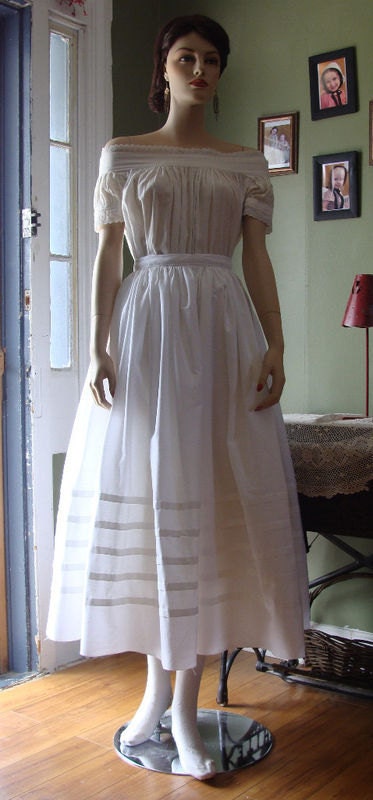
The petticoat that goes under the hoop for modesty is just that: a petticoat that goes under the hoop. This garment does not have a special name, it is just a petticoat. Many reenactors call it a modesty petticoat, but this term was not used during the period. It generally falls to around mid-calf.
 |
| Corded Petticoat - 1830s |
 |
| Hoop - 1856 |
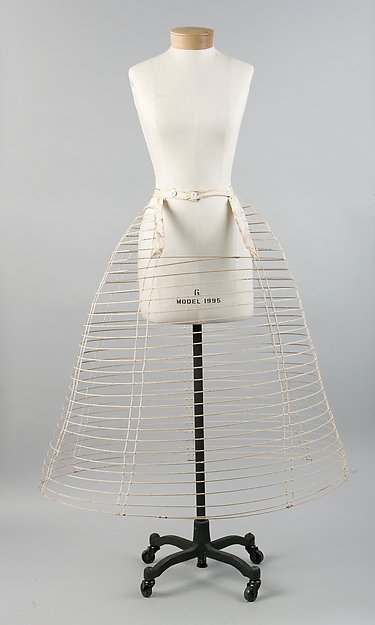 |
| Hoop - 1860 |
Skirt support in our era is extremely important. Before 1856, women relied on starched petticoats and the corded petticoat to give them the desired bell shape. When the hoop or cage crinoline emerged, it quickly took over. It was SO much easier to just put on a hoop and pop a starched petticoat or two over top. It was also much cooler. There might have still be some areas where women wore corded petticoats and they might have been worn for work/around fires, but the hoop reigned. The shape of hoops changed pretty rapidly and as the 60s progressed, back thrust and an elliptical shape emerged. The bottom rung of your hoop should not swish close to the ground, rather it should be about a foot from the ground.
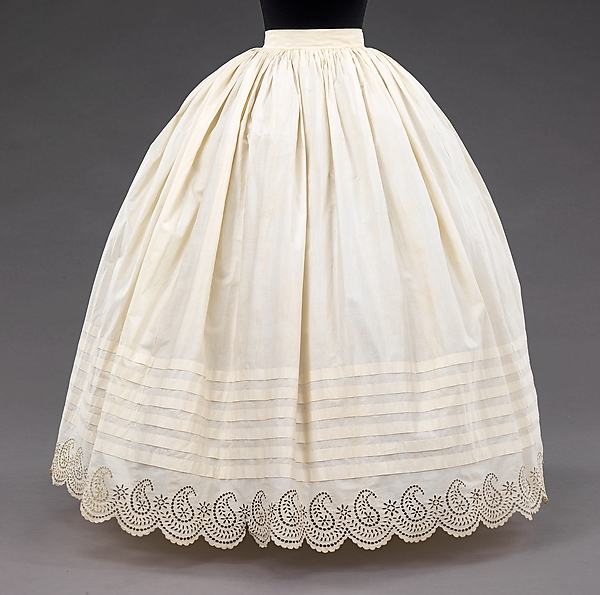 |
| Petticoat with broderie anglaise along the hem |
Here are a few other under garments that might be worn depending on the weather or type of dress.
 |
| Quilted Petticoat - these are seen on drawstrings or with waistbands and they were often prints or colored silks |
 |
| Corset Cover -1865 - not as commonly worn as later decades when the corsets became quite colorful, but useful for an unlined sheer dress |

No comments:
Post a Comment